
The Silent Agrarian Transition: Homestead Farming in the Climate-Affected Sundarbans
Anindita Bhattacharya
The climate crisis in the Sundarbans, a UNESCO World Heritage Site in India, is not merely an environmental issue; it is rapidly and violently restructuring the agrarian system that is already defined by deep inequalities of class, caste, and gender. In 2020, when cyclone Amphan struck, it exposed and accelerated a fundamental crisis of social reproduction for the delta’s smallholders. The collapse of input-intensive monoculture has rendered the dominant agricultural model in the region ecologically and economically unviable. In this vacuum, the homestead farming System (HFS) has emerged not as a simple coping mechanism, but as the core site of an endogenous and silent agrarian transition.
Socioecological Vulnerabilities and Agrarian Differentiation in Sundarbans
The vulnerability of the Sundarbans is socioecological, rooted in a historically differentiated agrarian structure and compounded by institutional and economic marginalization. Smallholders are often excluded from formal credit, while government policies often promote single-crop, input-intensive farming that weakens resilience and widens inequality. Class, caste, and gender shape every layer of this vulnerability, determining who can adapt, diversify, or migrate and who remains trapped in precarity. HFS, therefore, is not a generic adaptation strategy; its form and function are shaped by social position. For land-poor and women-headed households with limited resources, it becomes a critical site for securing food and a modest cash income. It is where social reproduction occurs, with households sustaining daily survival in the absence of viable agrarian alternatives. Crucially, the system serves as a safety net precisely because the ongoing agrarian transition in the region remains exclusionary. This blog argues that HFS thus offers both a model of ecological adaptation and a lens through which the classed and gendered inequalities of climate change and rural transformation become visible.
An Agrarian Political Economy of the HFS
The role of HFS is shaped by significant social differentiation. A decade ago, studies showed that for 91 per cent of marginal farmer households, a class defined by its proximity to landlessness, HFS contributed for roughly 28 per cent of total household income from just 0.1 hectares of land. This intense efficiency highlights its role as a subsidy to simple reproduction for the most vulnerable.
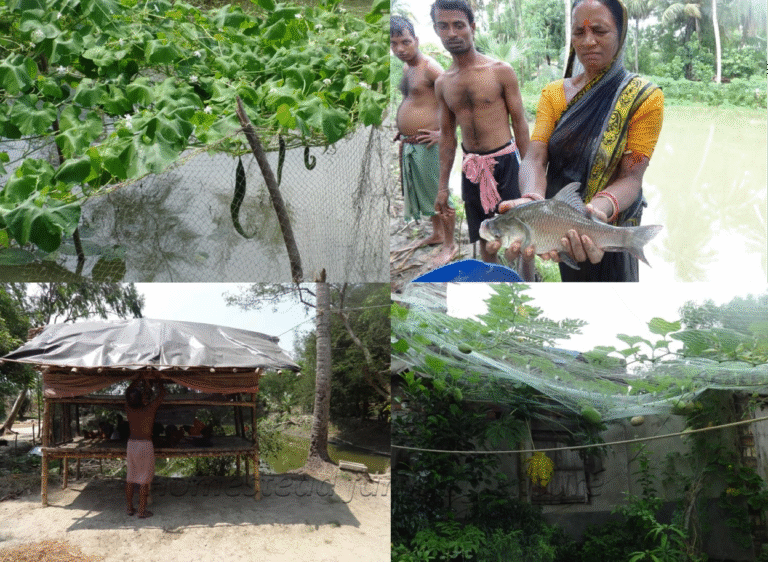
Analysed through Bernstein’s key questions: who owns, who does, who gets, and with what consequences, the system reveals its gendered dynamics. Typically, the male head of household holds a nominal title, while actual management is increasingly feminised. Women’s unrecognised work powers these integrated systems of horticulture, aquaculture, and animal husbandry. The household gains food and modest cash income, yet women’s critical labour often goes formally unrecognised, locking them out of extension services and credit. Consequently, the HFS becomes a site of survival and social reproduction by leveraging women’s unpaid labour to absorb systemic shocks. This is not a neutral adaptation but a gendered redistribution of climate risk. Traditionally viewed as supplementary, these homestead farms have increasingly become sites of survival, social reproduction, and quiet resistance. These systems function both as means of livelihoods and as dynamic laboratories where farmers experiment with local solutions to contemporary environmental challenges: optimising resource use, restoring degraded land, and mitigating socioeconomic vulnerability.
An Endogenous Agrarian Transition
The cyclonic triad has accelerated an unplanned agrarian transition in the Sundarbans. This transition is not a linear shift from subsistence to capitalism, but rather the collapse of an already fragile, commercial farming system. By salinizing fields and disrupting production, the cyclones have rendered this model increasingly unviable. In response, homestead farmers have emerged as active agents, reorganising production through brackish water aquaculture, salt-tolerant crop varieties, space optimisation through intensive agroforestry, floating cultivation, and stress-tolerant livestock. This endogenous transition reflects what agronomists termed ‘adaptive labour’, forms of agency exercised within the tight constraints of a failing rural capitalism. Unfolding outside formal policy, these adaptations are pragmatic yet politically significant. They represent a reorientation toward diversification, recycling, and low-risk production. However, this transition is profoundly uneven. Its movement is shaped by landholding size, varying from 0.03-0.1 hectare of homestead land, by labour availability, which is eroded by seasonal out-migration, and by access to informal capital, a near necessity when only 42.5 per cent of households can secure formal credit. It is a differentiated retreat from mainstream commercial agriculture, not a uniform progression.
HFS and Crisis of Social Reproduction
The HFS functions as a critical safety net for preventing a social reproduction crisis. Its diverse outputs provide a buffer against market and crop failures. Recent studies underscore this role in contributing 35 per cent of household income for farmers while reducing annual vegetable expenditures by approximately ₹9,500. It is a meaningful gain for small farmers. During the compound crises of pandemic lockdowns and cyclones, households with robust HFS maintained greater food access and nutritional diversity, contributing to an 11.7 percentage point reduction in poverty rates. These outcomes demonstrate that the HFS does more than supplement income; it enables the daily and intergenerational reproduction of labour under conditions of extreme agrarian insecurity. This constitutes its core role in everyday life. Yet, from a political economy perspective, this success is paradoxical. The system’s effectiveness reflects not policy success but the privatization and feminization of risk. Households, and particularly women within them, are compelled to absorb and manage shocks that nobody addresses adequately. The HFS becomes a social reproduction fix for the system, mitigating a crisis of legitimacy without redistributing resources or power. Climate-induced male out-migration has further intensified this dynamic, accelerating the feminization of agricultural management in the Sundarbans. Tasks once framed as “helping out” have become full-scale agricultural responsibility. As a feminized space of production, the HFS makes visible how gender is central to the reorganisation of labour, risk, and survival in this silent agrarian transition.
Policy reorientation towards political rights
Truly effective adaptation policies must engage the power structures that shape rural livelihoods. This requires moving beyond promoting ‘best practices’ to confront core political questions: Who owns? Who decides? And who benefits? Simply offering financial products or technical advice without changing the underlying system will only reinforce existing dependency. Instead, policy must aim to redistribute property, democratise power, and ensure meaningful participation in climate governance. This reorientation requires concrete reforms, including:
- Formal Recognition: Legally acknowledging HFS in policy documents as a productive agricultural unit is a foundational step. This must include:
- Securing Tenurial Rights: Formalising ownership rights, particularly for women farmers who manage but rarely own these plots, protecting them from dispossession.
- Political Visibility: Including HFS in agricultural censuses and economic planning, making the contributions of smallholders in policy and budget allocations.
- Redistributive Finance: Credit and insurance are necessary but ineffective when designed as standardised financial products that create debt traps for smallholders. A political economy approach demands democratically governed, non-extractive financial mechanisms:
- Community-Managed Funds: Credits and climate insurance for HFS should be managed by community collectives such as Primary Agricultural Credit Societies (PACS), Self-help Groups (SHG) and farmer-producer organisations (FPOs) to ensure accountability and prioritise need over creditworthiness.
- Social Insurance: Climate insurance should be jointly managed by the local government and community collectives. Premiums could be subsidised for collective losses (e.g., cyclones) rather than individual claims. This approach reduces individual burden and strengthens community solidarity.
- Gender-Sensitive Design: These programmes must directly support women by recognising their informal land rights as valid collateral for loans, offering flexible repayment schedules aligned with farming seasons rather than rigid banking calendars, and providing insurance that covers the full range of homestead farm products.
- Democratic Extension Services: Advisory services need to shift their focus from technology transfer to knowledge sharing and political empowerment.
- Extension as Organising: Agricultural advisors should act as community organisers who strengthen farmer collectives, document local innovation, and build capacity for political advocacy, rather than delivering instructions.
- Participatory Governance: Research agendas must be set by farmers and scientists together, prioritising the political-economic constraints farmers face, such as unfair markets, insecure land rights, etc., alongside agronomic solutions. This also supports building farmers’ collective strength.
- Grounded Knowledge System: A platform should be established within climate planning and funding bodies from the grassroots to the regional level, with representation from marginal farmers, women farmers, and landless labourers. This inclusive participatory system must offer substantive decision-making authority, ensuring that government climate initiatives address systemic inequity rather than reinforce it.
In summary, policy must move beyond funding to democratise HFS by redistributing control over resources, finance, and knowledge to the communities that already rely on it for adaptation.
Conclusion: The Imperative of Structural Change
The HFS in the Sundarbans is more than ecological adaptation; it has become central to how rural households negotiate an ongoing and uneven agrarian transition. Evolving from a supplementary garden, it now sustains social reproduction, and redistributing family labour, even as commercial agriculture becomes increasingly unviable. The growing importance of HFS reflects the failure of mainstream agrarian models under climate stress and market instability. The article proves a critical lesson: that adaptation without redistribution cannot constitute justice.While the HFS enables survival, it simultaneously privatizes the costs of the agrarian crisis, shifting the burden of adjustment onto households. Thus, the HFS operates an archive of adaptive labour and a base of social reproduction.
Yet, by subsidizing household survival, it also stabilizes an unequal political economy, mitigating its crises without challenging its foundations. The politics embedded in this duality are subtle but consequential: practices that sustain life under conditions of neglect can function as forms of quiet resistance and as mechanisms that reproduce the very system they endure. Addressing this contradiction requires moving beyond technical interventions to confront underlying political-economic inequalities of unequal market access, insecure land rights, and the systemic exclusion of women and the land-poor. In the Sundarbans, the humble homestead is where the future of the countryside is being quietly, unevenly, and stubbornly remade. It reveals that resilience is not only about enduring shocks, but about who holds the power to shape what follows.
Anindita Bhattacharya (aninditabhattacharya.87@gmail.com) is an Independent Researcher and Writer specialising in agrarian crisis, sustainable agriculture, small-scale farming (homestead farming), and rural livelihoods.