
The Patterns of Capital Intensification in Indian Agriculture
Jacob Joshy
For over a century, the Agrarian Question (AQ) has guided debates on rural transformation and the development of capitalist agriculture. At its core, the AQ asks: what happens to the peasantry as capitalism penetrates agriculture? Classical theorists, such as Lenin, envisioned two possible outcomes. Either small farmers would accumulate and become capitalist farmers, or they would be dispossessed and forced into wage labour. In both cases, peasant farming was expected to disappear.
However, in much of the Global South, and especially in India, this prediction has not come true. Peasants have neither vanished nor accumulated in a way that allows them to transform into capitalist farmers. In this blog, I argue that capital intensification has become the central driver of inequality in Indian agriculture, enabling accumulation for large farmers while pushing smallholders into greater dependence, higher risk, and continuous distress. Small farmers persist in precarious ways through cultivating small plots, supplementing incomes with wage work, and relying on markets for survival. This ‘incomplete transition’ has led Bernstein to reformulate the AQ around labour rather than capital. The question now is not whether capitalism enters agriculture; it clearly has, but how it reshapes rural class relations and what it means for smallholders who remain on the land.
This is where capital intensification comes into agriculture. In this context, it means the growing dependence of farming on market-purchased inputs—seeds, fertilisers, irrigation, fuel, machinery, and credit—rather than family labour or non-monetised resources. In India today, even the smallest farmers, who cultivate less than one hectare, must spend cash to buy inputs in order to reproduce their livelihoods. Capital intensification, therefore, is the mechanism through which the AQ unfolds in contemporary India. That is, farmers stay on the land, but under the imperative of the market.
The National Sample Survey Organisation (NSSO) Situation Assessment Survey (SAS) data (2012–13 and 2018–19) vividly illustrates this process when broken down by landholding class. Instead of a smooth transition toward capitalist farming, the data show a widening gulf between small and large cultivators, evidence that capital intensification has reinforced social differentiation rather than ensuring a smooth agrarian transition.
What the Data Shows: Landholding and Capital Intensification
The NSS Situation Assessment Surveys allow us to see how capital intensification plays out across different classes of farmers. Based on landholding size, farming households are classified into (i) Marginal farmers (Less than 1 hectare); (ii)Small farmers (1-2ha); (iii) Semi-medium farmers (2-4 ha); (iv) Medium farmers (4-10 ha); (v) Large farmers (10 ha and above). The patterns are striking.
Market Dependence Across all Farmers: Even marginal farmers, those cultivating less than one hectare, purchase about 70% of their inputs from the market (Table 1). For large farmers, this figure rises to over 84%. Purchased inputs include high-yielding varieties of seeds, fertilizers, pesticides, and weedicides, the cost of hired implements and machinery, irrigation and fuel, and credit. All these taken together show the extent of monetization as well as modernization of the input structure. This means that no one enjoys complete autonomy from the market. Whether rich or poor, farmers must farm in a context of existing property and market relationships, which compel them to purchase fertilisers, seeds, fuel, and irrigation to keep their farms going. But the ability to do so is vastly unequal. What follows from this is not a romantic search for peasant autonomy—an aspiration shared by most social classes—but an examination of how different farmers are unequally positioned within unavoidable relations of dependence, vulnerability, and control.
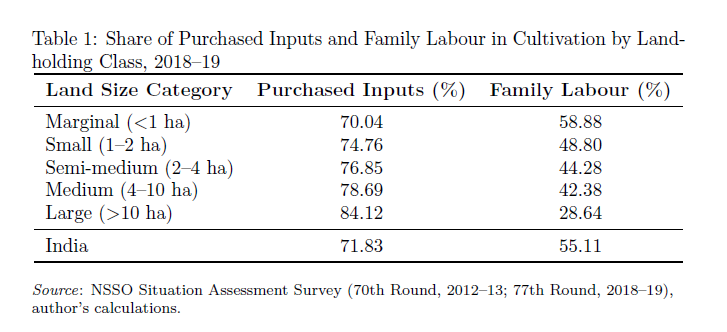
Family Labour vs. Mechanisation: Marginal farmers rely heavily on their own and family members’ labour, with about 59% of total labour coming from within the household. In contrast, large farmers depend on family labour for only 28% of their work, replacing it with hired workers or machines (Table 1). This tells us that small farmers survive by self-exploitation, while big farmers free themselves from this burden through mechanisation.
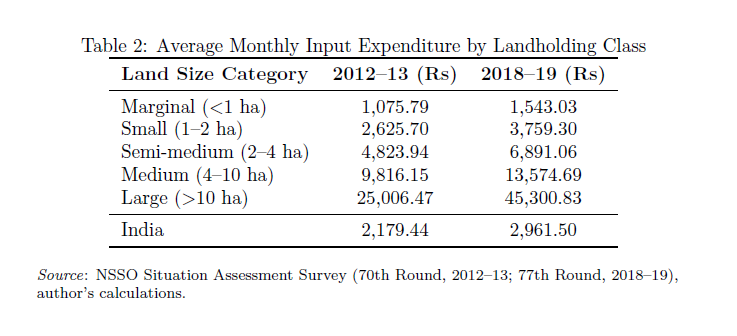
The Scale of Input Costs: The difference in monthly input expenditure is staggering. A marginal farmer spends about ₹1,500 per month, while a large farmer spends more than ₹45,000. In other words, large farmers are able to invest 30 times more in their farms. This relationship between capital intensification with scale economies of large farms indicates how intensification may translate into accumulation for some (Table 2).
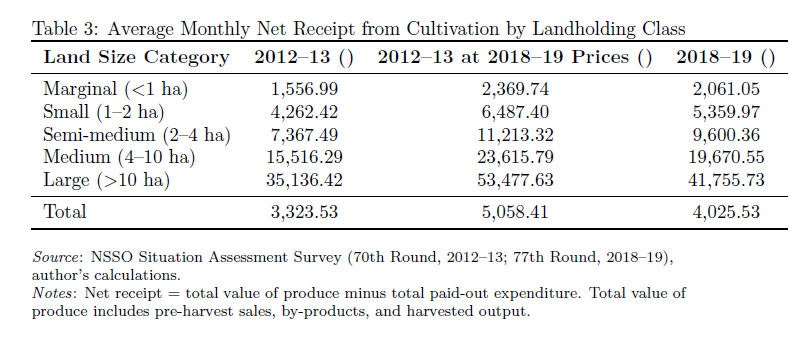
Net Receipts: Stagnation for the Majority: Has this higher spending made farming more profitable? The answer is sobering. Adjusted for inflation, average net receipts from cultivation have stagnated or even declined. Marginal farmers barely make around ₹2,000 per month, while large farmers earn over ₹40,000. The gulf has widened over time, meaning that intensification benefits only those who can afford to invest heavily (Table 3).
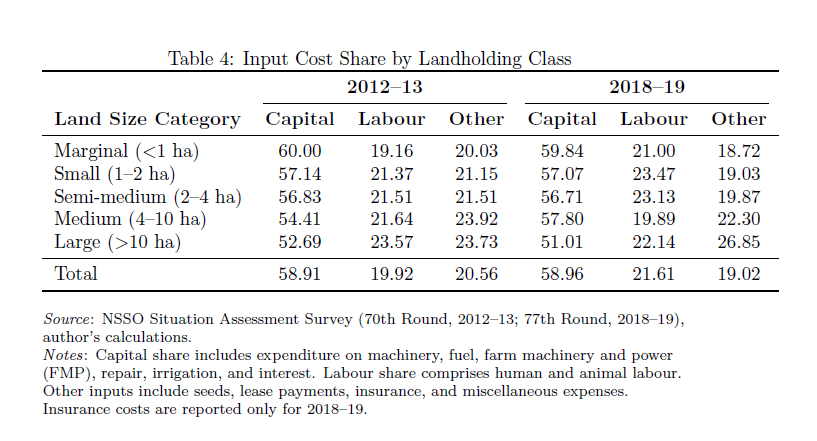
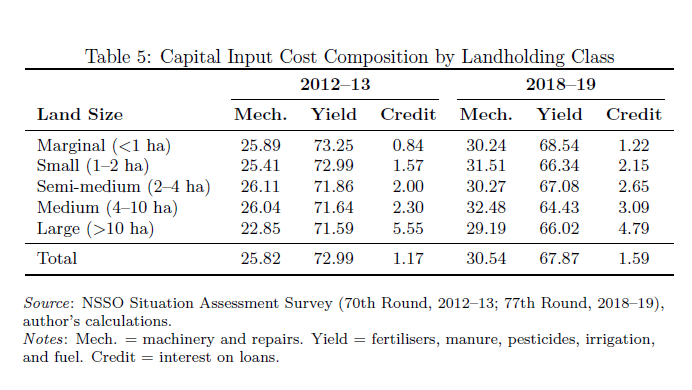
Composition of Costs: Rising Mechanisation and Credit: Across all landholding classes, about 60% of cultivation costs are capital-related—machinery, fuel, irrigation, and loan interest (Table 4). Within this, the share of mechanical inputs rose from 26% in 2012–13 to 31% in 2018–19 (Table 5). Credit dependence also crept up, with more farmers borrowing to sustain cultivation. Together, these trends show that farming is becoming more mechanised, more monetised, and more indebted.
Reading the Patterns
Three possible explanations emerge. First, improvements in the productivity of capital assets, particularly farm machinery, may have enabled farmers to sustain or even expand output without a proportional rise in capital expenditure. Evidence from long-term village studies shows that in highly commercialised and irrigated regions, yield-enhancing technologies (tube wells, borewells, drip irrigation, tissue culture) have raised productivity even with a relatively stable share of capital inputs. However, richer farmers tend to take advantage of scale to enter new spaces in production, marketing, and value addition opened by liberalisation and globalisation. These sections also continued to freely avail bank credit that was relatively restricted for the smaller farmers.
Second, in regions with high poverty incidence, farmers may be constrained from adopting expensive inputs, with stagnant or declining capital shares reflecting distress rather than efficiency gains. Village studies similarly observe that Scheduled Castes (SC), Scheduled Tribes (ST), and poorer Other Backward Castes households face severe constraints in adopting mechanisation or high-cost inputs, with landlessness and lack of credit access reinforcing these constraints. In fact, the decline in crop income, even when there was no apparent decline in productivity, points to problems of price realisation and high cost of inputs in the farm economy.
Third, the relative availability of cheaper rural labour in certain states could discourage mechanisation and capital-deepening. It is pretty much clear that labour markets in India remain segmented by caste and gender, with large pools of low-wage labour—especially women, SCs, and STs—remaining tied to agriculture or returning to it during periods of shock. This could reduce the incentive for farmers to invest in labour-saving machinery. Evidence also suggests an increasing trend of labour returning to agriculture, with the absolute number of workers in agriculture increasing to its highest-ever level of the last decade. In regions where unpaid family labour and casual agricultural labour remain abundant, farmers substitute labour for machinery, keeping mechanisation and capital intensity lower. In regions where unpaid family labour and casual agricultural labour remain abundant, farmers substitute labour for machinery, keeping mechanisation and capital intensity lower.
Overall, even though the productivity of major crops has increased over the years, the net returns from cultivation have declined. In the era of globalisation, the squeeze between rapidly rising input costs and stagnant or volatile output prices has accelerated this decline. The broader agrarian scenario is marked by falling or stagnant productivity in several crops, escalating production costs, shrinking profitability, persistent unemployment and underemployment, and rising indebtedness, all of which point to deepening agrarian distress.
Taken together, these numbers tell a clear story. Capital intensification is not a neutral process that boosts productivity for all. It is deeply uneven. Large farmers convert higher spending into higher returns, while small farmers face the paradox of being compelled to spend more but earning little to no surplus. For them, capital intensification does not lead to accumulation; it leads to greater vulnerability. In short, even as the emergence of large-scale agrarian capital from below remained constrained, differentiation of the peasantry was a work in progress. In other words, the Agrarian Question in India today is the question of capital intensification itself. That is how the advance of capitalist inputs and markets reshapes rural inequalities, without resolving the basic problems of agrarian distress.
Conclusion
The story of capital intensification in Indian agriculture brings us back to the Agrarian Question. Capitalism has unquestionably penetrated the countryside, not by displacing peasants en masse, but by compelling them to cultivate through the market. Even the smallest farmer must buy seeds, fertilisers, and fuel just to survive another season. Yet, this has not produced the broad-based prosperity once promised in mainstream modernization theory and policy prescriptions that followed. Instead, it has reinforced old divides. By land class, large farmers accumulate while smallholders face rising costs with stagnant returns.
The result is capitalism without resolution: peasants and rural petty commodity producers remain on the land, but in increasingly unequal and precarious ways. Despite the introduction of modern technology, resulting in increased labour productivity, labour still plays a major role in agriculture. At the same time, capital takes a significant part in determining output and property relations in agrarian societies. Unable to rely solely on agriculture or non-farm work, families diversify their labour across both sectors as a strategy of risk management in an increasingly uncertain economy. The growing prevalence of mixed households in India, therefore, reflects rural precarity rather than rural transformation. Overall, even as capital has penetrated agriculture with a rise in average productivity and capital formation, it has not led to any substantial growth in agriculture but rather what scholars call agrarian distress.
For policy, the lesson is clear. Schemes that focus narrowly on technology adoption or credit expansion risk treating the problem as technical, when it is deeply structural and political. What matters is not just whether farmers can access fertilisers or tractors, but who owns land, who can borrow affordably, and who bears the risks when costs rise and prices stagnate. Without addressing these structural inequalities, capital intensification will continue to reproduce distress rather than transformation in rural India.
Jacob Joshy (jacobjoshy06@gmail.com) is a PhD candidate in economics at the Centre of Regional Development, Jawaharlal Nehru University, Delhi.