
Book Review: Rashed Al Mahmud Titumir’s Why Agriculture Productivity Falls
Ritwika Patgiri
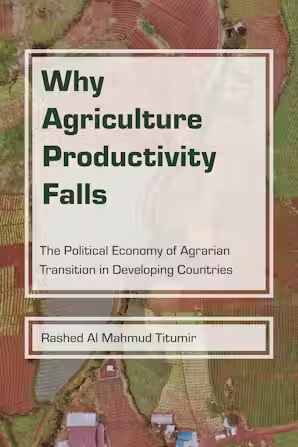
Rashed Al Mahmud Titumir’s Why Agriculture Productivity Falls: The Political Economy of Agrarian Transition in Developing Countries explores how agricultural productivity declines in the context of Bangladesh. The book is an important addition to the literature on understanding agrarian transitions in the developing world. By offering an alternate explanation for declining agricultural productivity in the Global South through the example of Bangladesh, the book demonstrates that the inverse relationship between farm size and agricultural productivity does not always hold true. While land fragmentation is increasing, it is not because of greater productivity of smallholders but due of increasing population. This does not necessarily lead to a rise in farm productivity or the distribution of landholdings to more productive users. The reasons and the political economy of land fragmentation are equally important and go beyond the capitalist agrarian transition.
The book is divided into seven chapters. The first chapter provides a theoretical background of land ownership and production relations and their relationship to agricultural productivity. By forming a critique of the neoclassical understanding of agricultural productivity through mechanisation, market liberalisation, and technological inputs, the chapter emphasises that productivity has a political economic aspect. Power dynamics, property rights, and political settlements are essential for understanding agricultural productivity. The second chapter provides ethnographic description of the four studies villages and empirically looks at the factors driving land fragmentation. This is a crucial chapter which gives a detailed understanding of the geographical, climatic, political, and social nuances of land fragmentation. The chapter further highlights the role of political power in controlling land transactions and the disparity between large and small landholders.
The third chapter discusses the important factors of production and revisits the debates on farm size and productivity. It outlines how small farmers face various structural constraints due to which the fragmentation of landholdings does not necessarily lead to an increase in productivity. The fourth chapter focuses on the persistence of smallholding agriculture in Bangladesh despite increasing landlessness. While there is evidence of primitive accumulation, such accumulation is not driven by the capitalist compulsion to produce more surplus, showing non-conformity with classical capitalist transition. The persistence of smallholding agriculture is not driven by greater productivity of the smallholders but because of demographic factors with rise in the population.
The fifth chapter highlights the importance of local class dynamics in driving agrarian change alongside primitive accumulation, intensive international migration, and penetration of technology. The chapter concludes that the exercise of power by the petite bourgeoise has important political and economic consequences, shaping the nature of accumulation and investment. Unproductive and short life span of primitive accumulation driven by political factions has resulted in low levels of long-term investment in productivity. The sixth chapter addresses sustainability and environmental challenges of agriculture. It shows how the initial benefits of the Green Revolution have led to an overreliance on fertilizers and pesticides, and depletion of natural resources. Building sustainable agricultural systems that can also meet the needs of a growing population becomes an important discussion in the context of climate change and intensive farming. The concluding chapter (chapter 7) contests the various theoretical positions on the relationship between market and non-market transactions and productivity growth in agriculture.
Size-Productivity Relationship in the Global South
One key theoretical position that the book contests is the existence of the inverse relationship between farm size and agricultural productivity. Studies in India have indicated that the inverse relationship between farm size and agricultural productivity does not hold true and smaller farms face higher costs and lower returns per unit of production. This implies that increasing production by small and marginal farmers remains susceptible to vulnerabilities of sustenance, leading to a failure of accumulating surplus and a distress-ridden rise of non-farm activities. Titumir’s analysis of smallholder agriculture in Bangladesh is driven by three important characteristics of rural change. First, there is increasing land fragmentation driven by demographic and climate reasons rather than concentration of land. Inheritance and succession of land reduces the average size of landholdings. Second, increasing fragmentation has led to a rise in the cost of production and land losses, alongside the growing role of fertilizers, pesticides, irrigation, and high yield variety seeds. Facing increasing costs, smallholders produce at a suboptimal level, with a ceiling on their level of productivity. Moderately large farmers were found to be more productive than smallholders as they can access and pay these input costs. This is in contradiction to the mainstream understanding of the relationship between farm size and agricultural productivity. Third, the relationship between large landholdings and productivity breaks down as different nuances of land emerge. Large farmers prefer to lease out or sharecrop their land, and use the earnings to expand their non-farm activities or to facilitate migration. The resulting influx of migrant remittances, however, does not drive agricultural productivity growth.
These findings are important because agrarian transition and productivity in the Global South cannot solely be understood in relation to market dynamics, as argued by the market-centric theoretical approaches. The role of land is interlinked with various socio-cultural aspects. The book reveals that land is transacted across the land-owning classes, irrespective of the size. Land transactions, the book finds, are not occurring in a way that facilitates capitalist development (as happened in the West). Land is not necessarily being shifted from less to more productive users, whether large or small. Instead, there is constant and gradual increase in land fragmentation. Succession and inheritance patterns along with population growth reduce average land size per holder. Land is also associated with power; rather than being transferred from less to more productive users, it is used for sharecropping in such cases. Farmers who are both tenants and owners, or those who have shifted from cultivation dominated by tenancy to cultivation dominated by ownership, have seen their productivity increase.
What Happens to the Landless?
Titumir’s findings indicate that the landless become labourers, engaging in both farm and non-farm activities, or migrate in search of work. Migration amongst the landless in the last two decades reflects one of the major changes in the agrarian context in the Global South. Declining farm income and rising costs of inputs along with the unavailability of non-farm opportunities in the village direct such migration patterns. Hence, while the landless are pushed into wage labour or migration, cultivation itself has increasingly become concentrated in the hands of smallholders. Land is not leased in or sharecropped by the landless, since they cannot afford the costs of agricultural inputs to sharecrop.
The withdrawal of landless workers from farm activities has also been seen in other countries of the Global South, including India. The withdrawal of landless workers from farm activities in the context of India, however, has a distinct caste-class dimension. For instance, marginalized and Dalit workers withdraw from the local agrarian economy because of social and political reasons. In Bangladesh, Titumir’s findings indicate that small and marginal farmers engage in leasing in land while large and medium farmers lease out their land. There is also village-level evidence of middle-income farmers leasing in land, sometimes to facilitate migration to the Gulf countries of family members.
Village Studies and Methods
Titumir’s book uses an ethnographic and census study of four villages in Bangladesh – Srimantapur in Comilla district, Char Lakshmi in Noakhali district, Bara Pakhia in Tangail district, and Dastika in Bogra district. Each of the villages represent different geo-climatic, demographic, and agrarian patterns of the country, ranging from issues of climate change to the high intensity of migration. Past village studies in Bangladesh have focused on understanding socio-economic, ethno-demographic, and political structures, along with linkages and interactions of the village with the outside world. Titumir’s approach, coupled with ethnographic description and broader macro-level analysis, addresses the limitations of inadequate coverage and lack of representativeness associated with village studies in Bangladesh.
The four representative villages were selected on the basis of stylized facts emerging out of Bangladesh but the author gives little detail about the data collection process. Shapan Adnan also notes that, along with representativeness, village studies should further compare and contrast their findings with other village studies in distinct agro-ecological zones. While Titumir’s study is grounded in theoretical arguments, he pays less emphasis on findings from other village studies conducted in Bangladesh. The book, however, is an important contribution to the literature on using village studies to understand the complexities of agrarian transition.
Ritwika Patgiri is a doctoral researcher in the Faculty of Economics, at South Asian University (SAU), New Delhi. Her PhD is on Rural Transformation and the Non-Farm Sector in Assam.