
Postcolonial Marxism, Capitalist Development and the ‘Political’ Agrarian Question

Subir Sinha
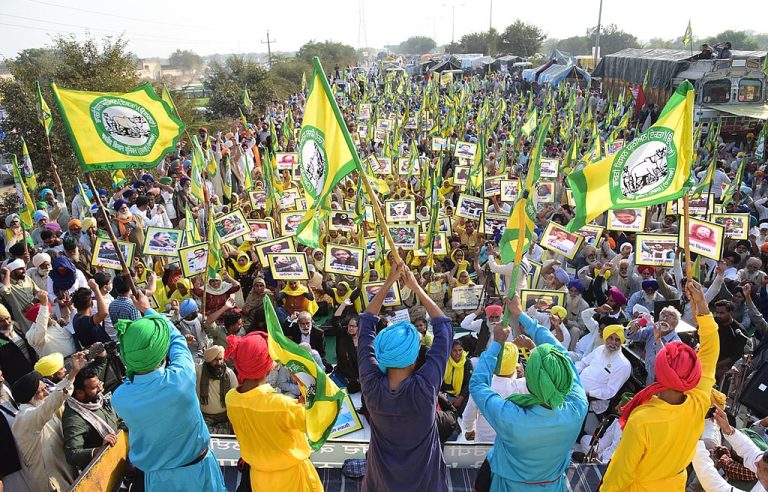
The emergence, fragile and temporary success, and ultimate neutralisation of the recent farmers’ movement in India provides an opportunity to revisit the ‘political’ agrarian question. The other classic ‘agrarian questions’, of capital and labour, have been substantially reworked in the context of neoliberal globalisation. In a nutshell, in contrast to the conditions of the late-19th and early 20th century when these questions were first formulated, the development of industrial capitalism today no longer needs surplus capital from agriculture, nor can labour made surplus by capitalist agriculture be fully absorbed in stable, formal industrial work (Bernstein 1996). These are significant deviations from the agrarian question as posed within canonical Marxism, and these have significant implications for the political agrarian question.
In this short piece, I want to suggest that re-working the ‘political’ agrarian question is key to reviving its relevance, both as an analytical and a strategic tool in relation to on-going struggles in agrarian settings. Such a re-working takes us further away from classical Marxism and in the direction of the approach calling itself ‘postcolonial Marxism’, that is, a Marxian-inspired analytic working with the difference between the original trajectories of Western Europe and on-going capitalist development in the global South. I also suggest that significant changes in objective conditions have taken place since the early articulation of this perspective (such as Sanyal 2007), and that postcolonial Marxist approaches to the political agrarian question themselves need revision.
The ‘original’ political agrarian question
Simply put, the political agrarian question asks: what should the strategy of socialist parties be in relation to the peasantry and other agrarian groups in conditions where capitalist relations and forms are dominant but not universal? (see Bernstein 1996). But even this succinct version contains multiple assumptions and implications that need to be unpacked.
If capitalist relations are ‘dominant but not universal’ over agriculture, then by implication some non-capitalist relations and forms ‘persist’, and retain some ‘autonomy’ from it, even as they may increasingly be oriented to capitalist relations. Thus, there is a first-order question: how do capitalist relations acquire dominance over non-capitalist ones, and how do the latter retain some autonomy such that capitalist relations do not become universal? A second-order question follows: since some degree of capitalist development in agriculture and industry has taken place (as is implied by their ‘dominance’), an ‘urban industrial working class’ and parties that represent it may already exist in the political field. How do they, assumed to be the more ‘advanced’ class, ‘lead’ those engaged in non-capitalist agriculture in a movement towards socialism?
Classically, capitalist relations become ‘dominant’ over non-capitalist relations via the unfolding of the immanent laws of capitalist development. The capitalist’s compulsion to accumulate and the dispossessed peasant’s, following class differentiation, to sell labour power in order to survive – the so-called ‘dull compulsions of economic relations’ – generate dynamics that split society in what Marx (in The Communist Manifesto) called ‘the two great classes’ – bourgeoisie and proletariat – and set the stage for a decisive struggle between them. The original statement of the political agrarian question, and indeed Marx and Engels’ writings, was set against a background where agrarian transitions were more or less complete, a strong industrial working class represented by powerful parties was evident and, despite national variations in the dominance of capitalism, the relative strength of the working class and the proletarianization of the agrarian classes were acknowledged. Socialism must have seemed, to its partisans, not only possible but also inevitable in such conditions.
However, various iterations of the political agrarian question in canonical Marxism concerned with the political potential of the peasantry recognised a more populated political field than just the ‘two Great Classes’. Engels, trying to understand the failure of the movements of 1848, returned to the peasant wars in 16th century Germany before capitalism achieved dominance and noted that the revolutionary potential of the ‘plebian’ classes (including both the peasantry and the proto-working class) was betrayed by the proto-bourgeoisie, which sided with the nobility. Marx, writing on the peasantry in the context of the rise of Louis Bonaparte and the civil wars in France, did not see such potential and notoriously likened them to “potatoes in a sack that make a sack of potatoes,” a conservative ‘class-in-itself’ but not a ‘class-for-itself’. Peasants, he averred, were incapable of political organisation and therefore of self-representation. They did not want “alliance with the towns”, accepted the leadership of landlords, and craved “unlimited governmental power which protects them from the other classes.” He recognised that peasants’ alliance with the emergent bourgeoisie was difficult given the latter’s financial interests in agriculture, which led to huge mortgages and dispossessions. Later, he saw the lack of a political link between workers and peasants, town and country, as a key reason for the fall of the Paris Commune and emphasised the need to forge such links.
Marx and Engels recognise, in different editions of The Communist Manifesto itself, considerable national difference in the universalisation of capitalist relations, their dominance over agrarian society as a whole, their ability to dissolve or internalise non-capitalist relations, the relative strength of socialist parties and working class organisations, the political potential and orientation of these classes, and the political fields on which they were in contestation with centrist and right-wing parties (see Sinha 2021). In later writings, Marx (in his letter to Vera Zasulich) suggests that in places like Russia, where peasant communities had not been dissolved by capitalist development, this already-existing collective could form the basis for building a coalition with working class organisations. In the context of Italy, Gramsci’s account of the politics of urban classes recruiting rural and migrant subalterns to different political projects, placed against the background of rapid transitions to capitalism and huge migrations of the rural dispossessed to factory work, was more open-ended: the changing peasantry as subaltern was open to recruitment into left, centrist and right-wing agendas, democratic and well anti-democratic.
In any event, the Russian revolution – a ‘revolt against Marx’, as Gramsci called it – and subsequently the Chinese, Vietnamese, and Cuban revolutions differed substantially from the canonical script. It was not in the sites of the most advanced capitalist transitions, but often the most ‘backward regions’ – where the dominance and thus the universalisation of capitalist relations was limited, and large peasantries persisted and were active agents of the revolutions – that the most momentous communist revolutions took place. Conversely, where capitalism was most advanced, as in Western Europe, working class organisations settled for a compromise with capitalism within social democratic compacts.
Postcolonial Capitalism and the Obsolescence of the Political Agrarian Question
To talk of postcolonial difference is not the same as to call this ‘exceptional’, as some critiques of postcolonial theory have done (Chibber 2013). Terms such as ‘postcolonial capitalism’ and ‘postcolonial Marxism’ emerge from the insistence of an irreducible difference in national experiences within transitions to capitalism in postcolonial settings compared to the paradigmatic trajectories of Western Europe. However, the insistence that this needs a different analytical approach – the idea of ‘different’ national trajectories to capitalist development – is not an invention of postcolonial theorists: it inhabits the centre of Marxist theorisation of the political agrarian question.
Amending the agrarian questions to changing conditions is an on-going task. As Bernstein’s (1996, 2006) germinal work has argued, the original agrarian questions did not capture the current dynamics of agrarian change in the global South facing neoliberal reforms, where transnational capital, rather than capital surplus from agriculture, funded industrial development. At the same time, surplus labour from agriculture was incompletely absorbed in non-agricultural work. Other studies also confirmed that, while class differentiation was proceeding, total polarisation was elusive leading to the existence of ‘classes of labour’. But are these conditions peculiar to the neoliberal era? Or do they have a longer history? And what are the implications of that longer history for the political agrarian question?
Capitalist development under colonial conditions relied on transnational capital and accumulation was oriented to the functional needs of empire. It was also spatially specific. While colonial capitalism had deep and wide impacts, it created small and geographically concentrated centres of industry, transport and commerce, and a similarly concentrated industrial working class. Agrarian society was profoundly impacted but maintained considerable autonomy from capitalist relations, including non-class (subaltern) forms of political subjectivity. In terms of the political agrarian question, capitalist relations were becoming dominant but were far from universal; working class organisations had emerged but nationalism was the dominant counter-hegemonic political project.
As Ludden (1992), Sinha (2008) and Gupta (1998) show, Indian postcolonial agricultural development was gradualist, partly to avoid putting agrarian classes through ‘the rigours of transition’ but also because, with very little irrigation, underdeveloped markets, and low levels of mechanisation, the development of capitalism in agriculture, and so its dominance and universalisation, remained low. The ruling elite’s compact with caste-identified landlords (via limited land reforms, high subsidies, etc.) maintained their power over rural society. As terms such as ‘feudal’ and ‘semi-feudal’, common in the Marxist analysis of the time, indicate, non-capitalist production relations and credit and other markets were widespread. Worker-peasant alliances came together from time to time under the Communist parties but from the 1960s, radical Maoist parties had emerged in some of the most ‘backward’ and ‘tribal’ regions of rural India, and then in the ‘tribal’ areas, zones of caste-based agrarian relations and primitive accumulation respectively.
Postcolonial approaches push the question of difference in capitalist development in postcolonial India further. In a key work of postcolonial theory, Chakraborty (2000) argued for the pluralisation of the history of global capitalist modernity, such that the history of the universalisation of capital is complicated by the history of other ‘antecedents to capital’ that lie outside of capital’s history and abrade against its ‘totalising thrust’. More recently, Chakrabarty, Cullenberg and Dhar (2017) argue that, in postcolonial settings, ‘capital’ does not mean the entirety of the ‘economy’ as in contexts where agrarian transitions are complete, and that there are relations of production and exchange uncolonised by capital. These contentions have implications for how the political agrarian question has developed in India.
Sanyal (2007) argues that successful agrarian transitions to capitalism require completed processes of primitive accumulation, which is not possible in contemporary postcolonial settings. Historically, primitive accumulation created complete dispossession and compelled the dispossessed to sell their labour power. The force and violence attending these processes preceded the granting of rights, including to democratic participation, to the victims of primitive accumulation. But today the variety of ‘rights’ held by the dispossessed has created a ‘need economy’ supported by an international development apparatus which remains somewhat autonomous of the logic of capitalist production and exchange (see also Dasgupta 2021). The ‘autonomy’ of agrarian classes is thus not ‘pre-capitalist’ and vestigial, but an on-going, contemporary and dynamic domain, though I would note that the satisfaction of ‘needs’ itself presents capital accumulation possibilities.
While Sanyal and Dasgupta provide a political logic to explain the continued presence of non-capitalist relations and the continued status of capitalist relations as ‘dominant but not universal’, they neglect the role of large agrarian movements from the 1970s in resisting the universalisation of capitalist relations in food, agricultural input and output markets, forestry, fisheries, land acquisition for industrialisation and, more recently, anti-mining movements in tribal areas. These were not movements of the ‘potatoes in a sack of potatoes’ but were networked transnationally with similar movements. Some, but not all, were loosely affiliated to the Maoist movement, targeted state governments led by the Communist parties, and projected class, caste, gender, regional and indigenous identities. Other movements such as the Right to Food Campaign, the Mazdoor Kisan Shakti Sangathan, the All-India Kisan Sammelans, and Chipko partially succeeded in pursuing demands for the right to food, employment, input subsidies, output support prices, and to common property in natural resources. While not quite the coexistence of ‘primitive accumulation and its reversal’ that Sanyal noted, these movements put some curbs on capitalist expansion and deepening, and cushioned the impact of neoliberal reforms on agrarian classes and the urban poor.
Sanyal’s theorisation was also set against two unacknowledged conditions that no longer apply. One, the power of the international development apparatus and discourses of human rights and democratic participation today is far less than in the early 2000s, when ‘inclusive neoliberalism’ was the prevailing doctrine. National variations then featured biopolitical development interventions and a rights-based ‘need economy’ protected the rural poor from the full play of capitalist logics of production and exchange. And two, the rise of authoritarian populism in donor nations (accompanied by debilitating cuts to aid) and the falling power of global civil society have weakened the power of the apparatus. The rise of authoritarian populism in India (see Sinha 2021) downgraded human rights, effectively prohibited social movements, and charged rights activists under draconian laws. The need economy is no more ‘rights based’ nor an outcome of democracy, and social movements of the poor and civil society in support of their demands are at a historical low.
Recasting the Political Agrarian Question for Contemporary Times
In concluding, let me return to the components of the classical statement of the political agrarian question and speculate on how, with conditions so different today in the global South, they may be amended to retain relevance. Postcolonial compacts between peasants and states, political coalitions competing to recruit the peasantry giving it bargaining power, international development and rights discourses and apparatuses, and flawed but functional democratic participation, together seem to validate Sanyal’s point that agrarian transitions in these locations will not be complete. The recent farmers’ movement in India (and indeed in Brazil and other parts of Latin America) also shows that alliances between different agrarian classes, and between them and working class parties and movements and progressive sections of the bourgeoisie, have kept the total universalisation of capitalist relations at bay. At a time when the agrarian question of labour is likely to remain unresolved, these movements should be seen as progressive rather than conservative, in that they defend livelihoods and ways of life against a rampaging capitalism that is incapable of offering the vast majority of rural classes the benefits – via employment and welfare – of early 20th century Europe. But these conditions, too, are in flux.
In the global shift to the authoritarian right, the panoply of rights that undergirded the ‘need economy’ is now vastly weakened. The contemporary postcolonial state has favoured capital heavily against workers, the rural poor and the environment, offering temporary palliatives not as rights of citizens but as bandages packaged as gifts of the leader to the subjects. The working class itself is vastly different; mostly precariously employed migrant labour whose political disorganisation became evident in the Covid pandemic (see Sinha 2021). Socialist parties too have supported the expansion of capitalist relations, as in Kerala and West Bengal. A transition to socialism is thus not on the horizon. Indeed, what ‘socialism’ might mean today itself is unclear, beyond some protections to workers, agrarian classes, subordinated castes and indigenous people. Socialist organisations and parties cannot claim to have the support of the majority of these social groups; the authoritarian right and parties based on caste and regional identities probably have greater support from them.
Regarding the rise of the paradigmatic working class of England, Marx, in his chapters on Primitive Accumulation, had noted a crucial ‘amnesia’. In the original transitions to capitalism, extended over centuries between the enclosures of the 16th century and the emergence of industrial capitalism in the 19th, the working class had “no memory of their connections” to the countryside. Today, in a context of ‘compressed capitalism’ (Da Costa 2014), and a time when labour is neither fully working class nor anymore a peasant but oscillates between the two, enduring hybrid political subjectivity is common. Calls for a ‘return to class’ as the fulcrum of socialist organisation seem voluntaristic in a context where class is not the dominant political identity of the exploited and oppressed.
Against the assumption that transitions to capitalism would be completed, and the ‘persistent’ peasantry would eventually become working class, postcolonial Marxism, while not posing an analogous question of its own, argues that the transition would be stalled, and so there would be no full transformation peasant to worker. I suggest that the conditions that validated the postcolonial Marxist position are now obsolete, primarily because authoritarian states have weakened rights of the dispossessed and use force to complete the transition. To speak to our times, the political agrarian question must be reframed thus: how should socialist parties, facing long-term decline, relate to the new workers and agrarian groups that do not primarily identify as classes? What progressive political project, indeed what kind of ‘socialism’, is possible in today’s conditions of authoritarian attempts to remove barriers to capitalist universalisation? This calls for an ‘Marxism without guarantees’ (Hall [1983]2022), free from the legacy of European transitions and futile hopes of their replications in the postcolonies, but free equally from the postcolonial Marxist position whose invocation of rights and needs and global apparatuses of development have been rendered obsolete by the great global rightward shift.
Subir Sinha is Reader in the Theory and Politics of Development at SOAS, University of London.
This is part of a series of specially curated blog posts in which authors are invited to reflect on the theme of ‘Agrarian Questions’, highlighting different, even novel, ways of interpreting and engaging with the core questions of agrarian political economy in different historical and contemporary contexts. The posts will be released over the coming months as part of the 25th year celebrations of the Journal of Agrarian Change. You can find the full series of blog posts here.